



Today’s patients don’t choose healthcare providers the same way they did a decade ago. They aren’t relying solely on recommendations from family members or waiting for referrals from their primary care physician. Instead, they’re searching on their smartphones for terms like “heel pain specialist near me” or “best podiatrist in my area,” reading online reviews, comparing clinic websites, and making decisions within minutes. In many cases, their first impression of your practice is formed long before they ever speak to your receptionist or step into your clinic.
This shift has changed the rules of practice growth. Marketing is no longer something reserved for large healthcare organizations or multi-location clinics. It’s become an essential part of running a successful independent practice. The encouraging fact is that effective marketing doesn’t require flashy advertising campaigns or enormous budgets. More often it’s about making your expertise easier to discover, your practice easier to trust, and your patient experience memorable enough that people naturally recommend you to others.
Growing a podiatry practice is therefore less about “selling” healthcare and more about removing barriers that prevent patients from choosing you. It’s about showing up where they’re already looking, answering the questions they’re already asking, and creating an experience that begins before the appointment and continues long after the treatment ends.
In this guide, we’ll explore practical, sustainable ways to attract more new patients without compromising the quality of care that defines your practice.
Build a Practice That Patients Can Find and Trust
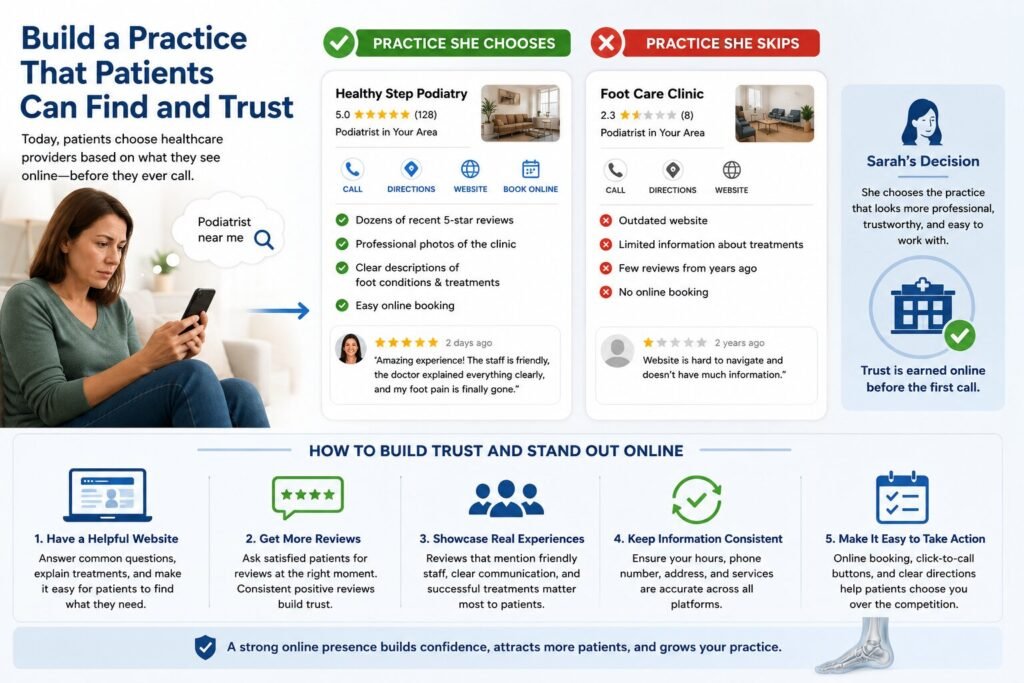
Imagine Sarah, a 42-year-old teacher who’s been dealing with heel pain for several weeks. She’s tried changing her shoes, stretching at home, and even taking over-the-counter pain relief, but nothing seems to help. One evening, frustrated after another painful day at work, she opens Google and searches for “podiatrist near me.”
Within seconds, she’s presented with several options. One practice has dozens of recent five-star reviews, professional photos of the clinic, clear descriptions of common foot conditions, and an option to book online immediately. Another practice has an outdated website that takes several seconds to load, minimal information about treatments, and only a handful of reviews from years ago.
Both podiatrists may be equally skilled, but Sarah is far more likely to contact the first clinic. Not because she knows which doctor provides better care, but because one practice has already earned her confidence before she even makes the call.
This scenario plays out thousands of times every day, and it highlights an important reality: patients often judge credibility based on what they can see online. That’s why your digital presence has become an extension of your practice.
Your website, for example, shouldn’t function as a digital brochure that simply lists services and contact information. Instead, it should answer the questions patients are already asking.
Your online reviews play an equally important role in building trust. Think of them as modern-day word-of-mouth recommendations. Patients aren’t necessarily looking for perfection, they’re looking for consistency. They want to see comments about friendly staff, clear communication, successful treatments, and positive experiences from people with similar concerns.
One of the simplest ways to increase reviews is to ask satisfied patients at the right moment. After a successful follow-up appointment, when a patient tells you they’re feeling significantly better, that’s often the perfect opportunity.
Trust also comes from consistency. If your clinic hours differ across your website, social media, and online listings, or your phone number is outdated in one directory, patients may question your professionalism before they’ve even met you. Taking the time to ensure your information is accurate across every platform creates a smoother experience and reduces unnecessary frustration.
Become the Podiatrist People Remember Before They Need One
Imagine a recreational runner who starts experiencing mild ankle discomfort during training. They aren’t ready to book an appointment yet, but they do search online for advice. If they come across an article from your practice explaining the common causes of running-related foot injuries, when to seek professional help, and simple steps to reduce strain, you’ve already made a positive first impression.
Maybe they don’t schedule an appointment that day. Perhaps they don’t even need one for several months. But when the discomfort worsens or another foot issue develops, your name is already familiar. You’ve earned something that’s incredibly valuable in healthcare marketing: trust before the first consultation.
Educational content doesn’t have to be complicated or overly technical. In fact, the most effective content often answers the simple questions patients are too embarrassed to ask. Why does heel pain feel worse in the morning? Can bunions be prevented? Are expensive running shoes really worth it? How often should diabetic patients have their feet examined?
Social media works in a similar way. Sharing practical foot care tips, introducing members of your team, celebrating community events, or explaining seasonal issues such as choosing supportive footwear during summer or preventing slips during winters keeps your practice visible without feeling promotional.
The goal isn’t to convince someone to book an appointment every time they see your content. It’s to remain present in their mind so that when they, or someone they know, eventually needs a podiatrist, your practice is the first one they think of.
There’s another often-overlooked aspect of becoming memorable: developing a recognizable identity for your practice.
Some clinics are known for sports medicine. Others become recognized as experts in diabetic foot care or pediatric podiatry. While you may treat a broad range of conditions, identifying an area where your practice particularly excels can help distinguish you in a crowded market.
That doesn’t mean turning away patients with different concerns. Rather, it gives your marketing a clearer message. Instead of trying to be everything to everyone, you become known for solving specific problems exceptionally well. Over time, this reputation often extends beyond that niche, leading patients to trust you with a wider range of foot and ankle conditions.
Ultimately, successful marketing isn’t about constantly telling people you’re the best podiatrist in town. It’s about consistently demonstrating your expertise, showing genuine care for your community, and making your knowledge accessible long before someone walks through your doors.
Turn Every Patient Into a Long-Term Advocate
When people talk about healthcare marketing, they often focus on getting more website traffic, improving search rankings, or running online ads. While all of those strategies have their place, none of them can compensate for a disappointing patient experience. In healthcare, reputation isn’t built by marketing campaigns alone; it’s built in consultation rooms, at reception desks, and through the countless small interactions that shape how people feel about your practice.
Think about the last time you received exceptional service, whether it was at a restaurant, a hotel, or another healthcare provider. Chances are, what stood out wasn’t just the quality of the service itself. It was how you were treated. You felt listened to, respected, and cared for. Those experiences are the ones we naturally tell our friends and family about.
Patients are no different.
For many people, visiting a podiatrist isn’t just about foot pain. It’s about regaining the ability to enjoy everyday life. It might be the grandfather who wants to walk comfortably with his grandchildren again, the young athlete eager to return to the football field, or the office worker whose heel pain has made every commute exhausting. Behind every appointment is a person whose daily routine has been disrupted, often for weeks or even months.
Recognizing that emotional side of patient care can transform the entire experience.
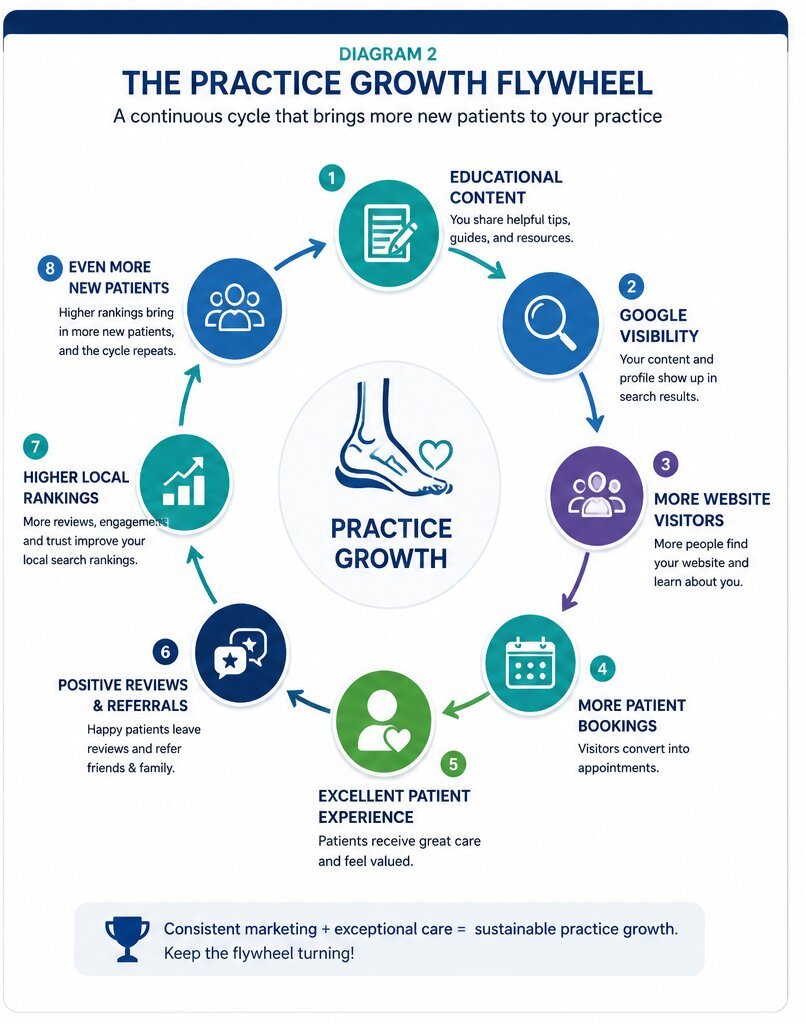
Satisfied patients naturally become storytellers. They mention their experience to colleagues at work, recommend your clinic to family members, or answer a neighbour’s question when someone complains about foot pain. Unlike paid advertisements, these recommendations come with something money can’t buy: personal credibility.
However, referrals don’t happen by accident. They happen because every stage of your patient journey consistently exceeds expectations.
One podiatrist I spoke with described a patient who initially visited for chronic heel pain. After several months of treatment, the patient recovered well and returned to her regular exercise routine. Over the following two years, she referred her husband, her elderly mother, two colleagues from work, and eventually even her teenage son following a sports injury. None of those referrals came because she was offered a discount or asked to participate in a formal referral programme. They happened because she genuinely believed the clinic had changed her quality of life.
Stories like this are surprisingly common.
Patients rarely recommend healthcare providers because of sophisticated marketing campaigns. They recommend professionals who make them feel cared for, respected, and understood.
Rather than waiting for patients to remember your clinic months or years later, stay connected in ways that provide genuine value.
A monthly email newsletter, for example, doesn’t have to promote appointments constantly. It can share seasonal foot care advice, explain common misconceptions, introduce new treatment options, or answer questions patients frequently ask during consultations. The objective isn’t to fill every newsletter with marketing messages. It’s to remain a trusted source of information.
When patients continue learning from you between appointments, they continue thinking about your practice.
The same philosophy applies to social media and other communication channels. Every piece of content should answer a question, solve a problem, or reassure someone who’s experiencing discomfort. Over time, this consistency reinforces your reputation as a dependable healthcare professional rather than someone who only communicates when trying to generate business.
Measure What Actually Brings New Patients
After spending time and effort improving your online presence, engaging with your community, and creating memorable patient experiences, there’s one final piece of the puzzle that often gets overlooked that is understanding what’s actually working.
It’s surprisingly common for practice owners to invest in marketing activities simply because they’ve always done them. They continue paying for print advertisements, sponsoring events, or posting on social media without ever asking a simple question: How many new patients did this actually bring to the practice?
Marketing should never be based on guesswork.
That doesn’t mean you need sophisticated analytics software or a full-time marketing team. Sometimes the most valuable insights come from asking every new patient a straightforward question during the registration process: “How did you hear about us?”
The answers can be incredibly revealing.
You may discover that the expensive magazine advertisement you’ve been renewing every year has produced only a handful of patients, while the blog article you published six months ago continues attracting people every week. You might find that most new patients come through Google reviews, referrals from local physiotherapists, or recommendations from existing patients rather than the marketing channel you assumed was your strongest.
Those insights allow you to make smarter decisions.
Rather than trying to be everywhere at once, you can focus your time and budget on the activities that consistently deliver results. Marketing becomes less about doing more and more about doing the right things well.
It’s also important to understand that not every strategy works at the same speed.
Some efforts deliver almost immediate results. Paid advertising, for example, can generate enquiries within days if it’s well targeted. Others require patience. Search engine optimization, educational content, and community reputation often take several months before their full impact becomes visible. Many Podiatrists abandon these long-term strategies too early, assuming they aren’t working, when in reality they’re laying the foundation for sustainable growth.
It’s equally valuable to pay attention to where patients stop engaging with your practice.
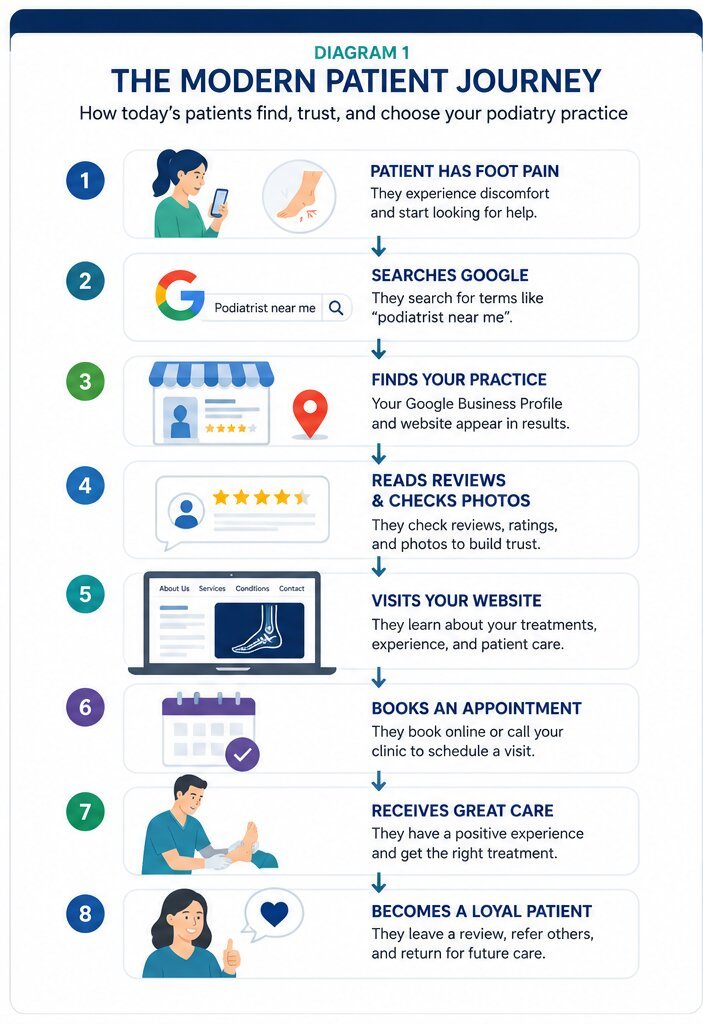
Perhaps your website attracts plenty of visitors, but very few book appointments. That may suggest your booking process is too complicated or your contact information isn’t easy to find. Maybe your Google listing receives hundreds of views every month, but patients choose another clinic instead. In that case, your reviews, photographs, or practice description may need attention.
Every stage of the patient journey offers clues about where improvements can be made.
Just as importantly, don’t be afraid to adapt.
Healthcare marketing isn’t static. Patient behaviour continues to evolve, new digital platforms emerge, and local competition changes over time. The strategies that helped your practice grow five years ago may not be enough today. The most successful podiatrists aren’t necessarily the ones with the biggest marketing budgets, they’re the ones willing to learn, test new ideas, and refine their approach based on real results.
One mistake many healthcare professionals make is believing that marketing ends once their appointment calendar is full. In reality, that’s often the best time to continue investing in your visibility. A consistent marketing strategy protects your practice against seasonal fluctuations, staff changes, and increasing competition while ensuring that new patients continue discovering your clinic month after month.
Perhaps the most important metric of all isn’t website traffic or social media followers—it’s patient trust.
If patients arrive feeling confident because they’ve read your educational content, seen authentic reviews, and heard positive recommendations from people they know, your marketing has already done much of its job before the consultation even begins.
And if those same patients leave feeling genuinely cared for, they’re likely to become part of your marketing for years to come.
Frequently Asked Questions
1. How long does it take to see results from podiatry marketing?
It depends on the strategy you’re using. Paid advertising can generate enquiries within days, while search engine optimisation, content marketing, and reputation building typically take several months to gain momentum. The practices that experience the most sustainable growth are usually those that combine short-term tactics with long-term investments rather than relying on a single approach.
2. Do podiatrists really need a website if patients can find them on Google?
Absolutely. Your Google Business Profile may encourage someone to click, but your website often determines whether they decide to book. Patients want to understand your expertise, learn about the conditions you treat, see who they’ll be meeting, and feel reassured before making an appointment. A professional, easy-to-navigate website builds confidence in a way that a business listing alone cannot.
3. What’s the most effective way to encourage patient referrals?
The strongest referrals come naturally from exceptional patient experiences. When people feel listened to, understand their treatment plan, and achieve positive outcomes, they’re much more likely to recommend your practice to friends and family. Asking satisfied patients to leave a review or share your details with someone who may need help is perfectly appropriate as long as it’s done respectfully and without pressure.
4. Is word-of-mouth still important in today’s digital world?
More than ever. The difference is that word-of-mouth now extends beyond conversations between friends. Online reviews, local Facebook recommendations, community groups, and patient testimonials have become digital versions of traditional referrals. Together, they influence how prospective patients perceive your practice before they ever contact you.
Conclusion
The practices that continue to grow year after year understand that every interaction matters. A helpful blog article can reassure someone who’s worried about persistent foot pain. A welcoming receptionist can ease the anxiety of a first-time patient. A thorough consultation can build trust, while a thoughtful follow-up call can transform a satisfied patient into someone who enthusiastically recommends your clinic to others.
When these individual moments come together, marketing stops feeling like marketing. Instead, it becomes a natural extension of the care you already provide.
As you think about the future of your practice, resist the temptation to implement every marketing strategy at once. Instead, choose one or two areas where you can make meaningful improvements. Perhaps it’s updating your website, collecting more patient reviews, strengthening relationships with local healthcare providers, or committing to publishing educational content consistently. Small, focused changes are often far more effective than trying to overhaul everything overnight.
Remember that patients aren’t simply looking for someone who can treat heel pain, bunions, or sports injuries. They’re looking for someone they trust to improve their quality of life. Every effort you make to educate, communicate, and care for people both online and in person helps build that trust.
In the end, sustainable practice growth isn’t driven by clever advertising or the largest marketing budget. It’s driven by reputation, relationships, and a genuine commitment to helping people. When your expertise is visible, your communication is authentic, and your patient experience consistently exceeds expectations, new patients don’t just find your practice; they choose it with confidence, return when they need care again, and encourage others to do the same.
That’s the kind of growth that lasts.