


Key Takeaways
- Target high-intent local searches: Focus on treatment-specific keywords and structured campaigns to attract patients who are ready to book an appointment.
- Optimize beyond the ad: Dedicated landing pages, strong trust signals, and mobile-friendly design significantly improve conversion rates.
- Track and refine continuously: Monitor calls, leads, and key performance metrics to optimize campaigns and maximize your Google Ads ROI.
Introduction
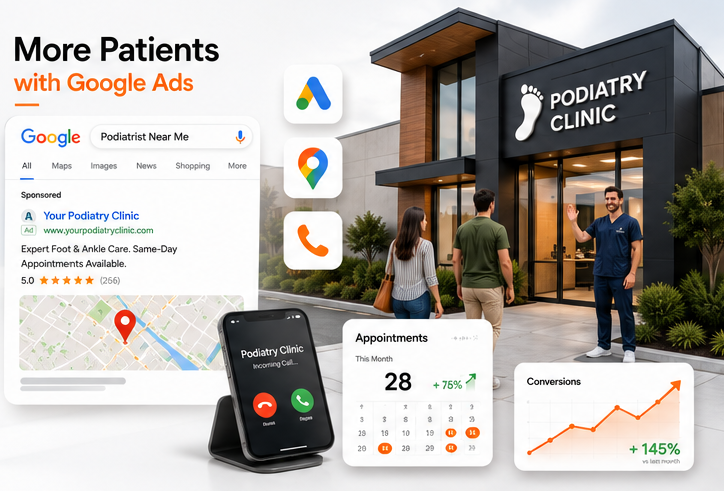
If you want to attract more local patients to your podiatry clinic, Google Ads for podiatrists is one of the most effective podiatry marketing strategies. A well-planned Podiatry Google Ads campaign helps your clinic appear in front of patients actively searching for treatment. When people experience foot or ankle pain, they usually search Google for immediate help. Google Ads places your clinic in front of these high-intent patients exactly when they’re looking for treatment.
With the right Google Ads management strategy, Google Ads can increase website traffic, generate more phone calls, and help fill your appointment calendar. It also provides valuable performance data, allowing you to optimize campaigns over time and improve your return on investment.
In this guide, you’ll learn the best Google Ads strategies to help your podiatry practice generate more qualified patient leads.
Why Advertise on Google?
Google remains the world’s largest search engine, making Healthcare Google Ads one of the most effective ways for podiatry clinics to connect with patients actively searching for foot and ankle treatments.
Google reports that businesses earn an average of $8 for every $1 spent on Google Ads. More importantly, many competing podiatry clinics are already advertising. If your practice isn’t running Google Ads, your competitors are likely appearing before you in search results, capturing patients who could have contacted your clinic instead.
For clinics investing in digital marketing for podiatrists, Google Ads provides immediate visibility while supporting long-term patient growth.
Google Ads Best Practices
1. Focus on High-Intent Keywords
Choosing the right Google Ads keywords determines whether your PPC for podiatrists campaign generates booked appointments or simply attracts website visitors. Avoid broad keywords that attract users looking for information rather than treatment.
For example:
- “Plantar fasciitis” often attracts users researching symptoms or home remedies.
- “Plantar fasciitis doctor” attracts people actively looking to book an appointment.
- Monitor keyword performance regularly and keep refining your targeting based on conversions rather than clicks alone.
2. Build a Campaign Structure That Converts
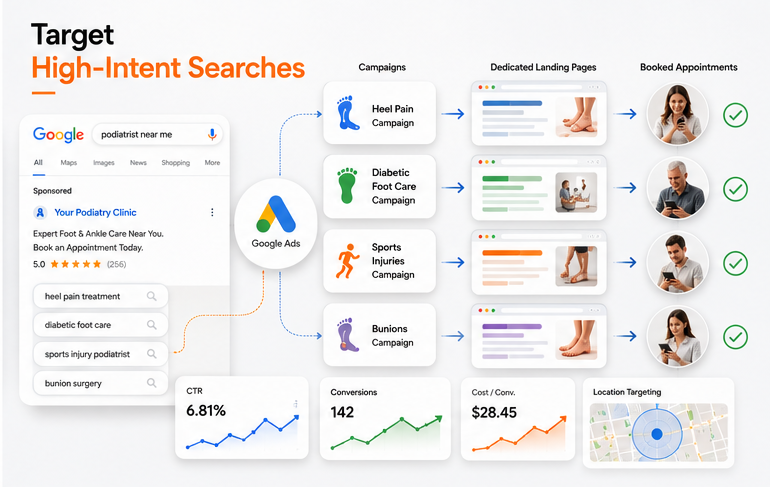
Many podiatry clinics struggle with Google Ads because they place every service into one campaign.
Instead, create separate campaigns for major treatment categories such as:
- Heel Pain / Plantar Fasciitis
- Diabetic Foot Care
- Sports Injuries
- Bunions and Surgical Procedures
This structure allows you to:
- Allocate budgets based on profitability
- Write highly relevant ads
- Send visitors to dedicated service pages
- Improve conversion rates through better relevance
A well-organized Google Ads campaign structure improves Quality Score, increases ad relevance, and makes Google Ads optimization much easier over time.
3. Use Local Service Ads (Google Guaranteed)
Local Service Ads (LSAs) appear above standard search ads and include the trusted Google Guaranteed badge. Unlike Search Ads, LSAs charge on a pay-per-lead basis instead of pay-per-click.
Benefits include:
- Greater trust through the Google Guaranteed badge
- Higher visibility
- Better quality leads
- Lower acquisition costs
Combining Local Service Ads (Google Guaranteed) with Search campaigns allows podiatry clinics to dominate search results, increase trust, and generate more local patient enquiries
4. Use Call-Only Campaigns for Urgent Searches
Patients searching for urgent conditions like ingrown toenails or severe heel pain often want immediate assistance. Call-only campaigns encourage users to phone your clinic directly instead of visiting a landing page, reducing friction and improving conversion rates.
Reserve these campaigns for urgent-intent keywords to maximize your advertising budget.
Call-only ads work particularly well for urgent conditions and help podiatrists convert high-intent searches into immediate phone enquiries.
5. Write Ad Copy That Builds Trust
Effective Google Ads copywriting should address the patient’s symptoms, build trust, and encourage immediate action.
Instead of generic messaging, focus on specific symptoms patients are experiencing, such as:
- Sharp heel pain
- Ingrown toenails
- Numb toes
6. Build trust by highlighting:
- Board-certified specialists
- Years of experience
- Insurance accepted
- Same-day appointments
7.Finish every ad with a clear call to action, such as:
- Book an Appointment Today
- Call Now
- Schedule Your Visit
Simple, direct CTAs consistently outperform vague phrases like “Learn More.”
Landing Page Best Practices
Even the best Google Ads campaign can fail if it sends visitors to the wrong page. Your landing page should continue the same message that convinced someone to click your ad and make it easy to book an appointment.
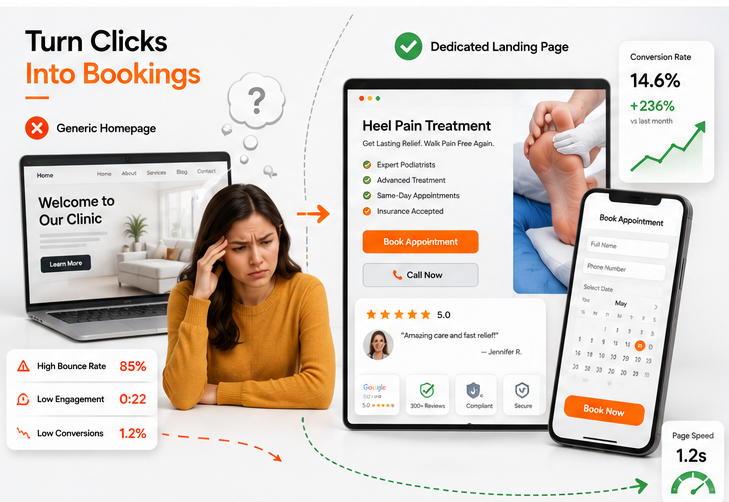
Don’t Send Paid Traffic to Your Homepage
One of the biggest mistakes podiatry clinics make is directing ad traffic to a generic homepage. Instead, every campaign should have its own dedicated landing page. For example, if someone searches for heel pain treatment, they should land directly on a heel pain page not a general services page.
Dedicated Google Ads landing pages improve ad relevance, increase Quality Score, support landing page optimization, and significantly improve conversion rates.
What We’ve Learned from Marketing Podiatry Clinics
One consistent pattern we’ve observed is that podiatry practices achieve stronger results when campaigns are organised around individual treatments rather than a single generic campaign. Creating dedicated ads and landing pages for services such as heel pain, diabetic foot care, and bunions helps match patient intent more closely, improving both enquiry quality and conversion performance. This structured approach also makes it easier to optimise budgets based on the treatments that generate the best outcomes.
This approach has consistently improved patient lead generation and made Google Ads management more efficient by allowing each treatment campaign to be optimized independently.
1.Build Trust Immediately
Patients evaluate your clinic within seconds of visiting your website. Include trust-building elements such as:
- Genuine patient reviews and testimonials
- Before-and-after photos (where applicable)
- Board certifications and professional affiliations
- Accepted insurance logos
These signals help reassure first-time visitors and encourage them to book an appointment.
2.Optimize for Mobile
Many patients search for podiatrists on their phones, often while experiencing pain. Your landing page should:
- Load quickly
- Be mobile-friendly
- Include thumb-friendly buttons
- Display a prominent click-to-call button
A slow or difficult-to-use page can lead to lost appointments.
Keep Booking Simple
Once a visitor decides to contact your clinic, don’t create unnecessary barriers.
Best practices include:
- A short booking form asking only essential details
- A visible phone number above the fold
- Optional online appointment scheduling
Reducing friction helps convert more visitors into patients.
3.Tracking, Conversions & ROI
Running Google Ads for podiatrists without proper Google Ads conversion tracking makes it impossible to identify which campaigns, keywords, and ads generate new patients.
Set up tracking for:
- Phone calls
- Contact form submissions
- Call duration and quality
This allows you to identify which campaigns, keywords, and ads produce real patient enquiries instead of just clicks.
4.Real Campaign Insight
We’ve seen the impact of data-driven optimisation in healthcare campaigns firsthand. For one podiatrist, implementing continuous Google Ads optimisation, refining keyword targeting, and closely tracking conversions helped generate thousands of patient enquiries while achieving a strong return on ad spend. The biggest improvement didn’t come from increasing the budget. It came from making better decisions based on performance data
5.Use Google Ads Conversion Tracking
Google Ads Conversion Tracking helps automated bidding optimize for conversions, while Google Analytics 4 provides insights into user behavior after they click your ad.
Together, Google Ads and GA4 provide valuable insights for Google Ads optimization, helping clinics improve campaign performance and return on investment over time.
Rather than focusing only on clicks and impressions, track:
- Cost Per Lead (CPL)
- Cost Per Acquisition (CPA)
- Conversion Rate
- Return on Ad Spend (ROAS)
Review these metrics regularly to understand what’s driving profitable patient growth.
Common Google Ads Mistakes
Even well-designed campaigns can underperform because of a few common mistakes.
1. Sending Traffic to the Homepage
Every ad should direct users to a relevant service page instead of a general homepage. Matching the landing page to the user’s search intent improves conversions.
2. Ignoring Negative Keywords
Without negative keywords, your ads may appear for irrelevant searches like:
- Podiatry schools
- Podiatrist salary
- Home remedies
Regularly updating your negative keyword list ensures your budget is spent only on searches with patient intent.
3. Not Tracking Calls and Leads
Without conversion tracking, it’s impossible to know which campaigns or keywords are generating new patients. Proper tracking allows you to invest more in what’s working and eliminate wasted spend.
4. Overlooking Local Service Ads
Many clinics focus only on Search campaigns and miss opportunities to appear higher in search results with Google Guaranteed Local Service Ads, which can generate high-intent leads at a lower cost.
5. Budgeting & Bidding Strategy
Your Google Ads budget should reflect your market, competition, and the lifetime value of a patient not simply what feels affordable.
6. Choose the Right Budget-
Choosing the right Google Ads budget and bidding strategy is critical for achieving sustainable growth while controlling advertising costs.
Budget requirements vary depending on your location and competition:
- Smaller markets: $1,500–$3,000/month
- Competitive metro areas: $3,000–$6,000/month
- Multi-location or surgical practices: $6,000–$10,000+/month
Think about how much a new patient is worth to your practice rather than focusing only on monthly spend.
7. Manual vs. Automated Bidding
For new campaigns, manual bidding offers greater control while you collect performance data.
Once your account has enough conversion history, automated strategies such as Maximize Conversions or Target CPA can improve efficiency. Avoid switching to automation too early.
8. Optimise Bid Adjustments
Improve campaign performance by adjusting bids based on:
- Geographic areas close to your clinic
- Mobile searches with high booking intent
- Office hours when staff are available to answer calls
These adjustments help ensure your budget is spent where it’s most likely to generate appointments.

FAQs
1. What are the best Google Ads keywords for podiatrists?
Use high-intent, treatment-specific keywords such as heel pain doctor, diabetic foot care, or bunion treatment rather than broad informational terms.
2. How can podiatrists improve Google Ads conversion rates?
Create dedicated landing pages, use conversion tracking, add negative keywords, and regularly optimize campaigns based on performance data.
How Magic Clickz Helps Podiatry Clinics Grow
Creating a successful Google Ads campaign is more than setting a budget and writing a few ads. To consistently generate new patients, every part of your campaign from keyword targeting and ad copy to landing pages and conversion tracking needs continuous optimization. Managing all of this while running a busy podiatry practice can be challenging.
At Magic Clickz, we specialize in Google Ads management for podiatrists and healthcare providers. As a specialist healthcare PPC agency, we create high-converting campaigns designed to generate qualified patient enquiries and maximize your advertising investment.
Our Approach Includes:
- Custom campaign structures tailored to your podiatry services instead of one-size-fits-all campaigns.
- Local Service Ads (Google Guaranteed) setup and management to help your practice gain more visibility and attract ready-to-book patients.
- Conversion-focused landing pages that match your ads and encourage visitors to schedule appointments.
- Complete conversion tracking and reporting, including call and form tracking, so you know exactly which campaigns are generating patients.
- Ongoing campaign optimization, with regular bid adjustments, ad testing, and audience refinement to improve results over time.
- Rather than relying on trial and error, we help podiatry clinics build a predictable, measurable Google Ads strategy focused on sustainable patient growth.
Ready to improve your Google Ads performance? Book a Google Ads audit with Magic Clickz. We’ll review your current campaigns, identify opportunities for improvement, and recommend a strategy tailored to your practice without any obligation.