

We’re a team of digital growth experts sharing insights, tips, and resources to help businesses perform better online. Simple. Actionable. Effective.
We’re a team of digital growth experts sharing insights, tips, and resources to help businesses perform better online. Simple. Actionable. Effective.
Google Ads has quietly rolled out an update that changes how advertisers can plan and control spend for short-term campaigns.
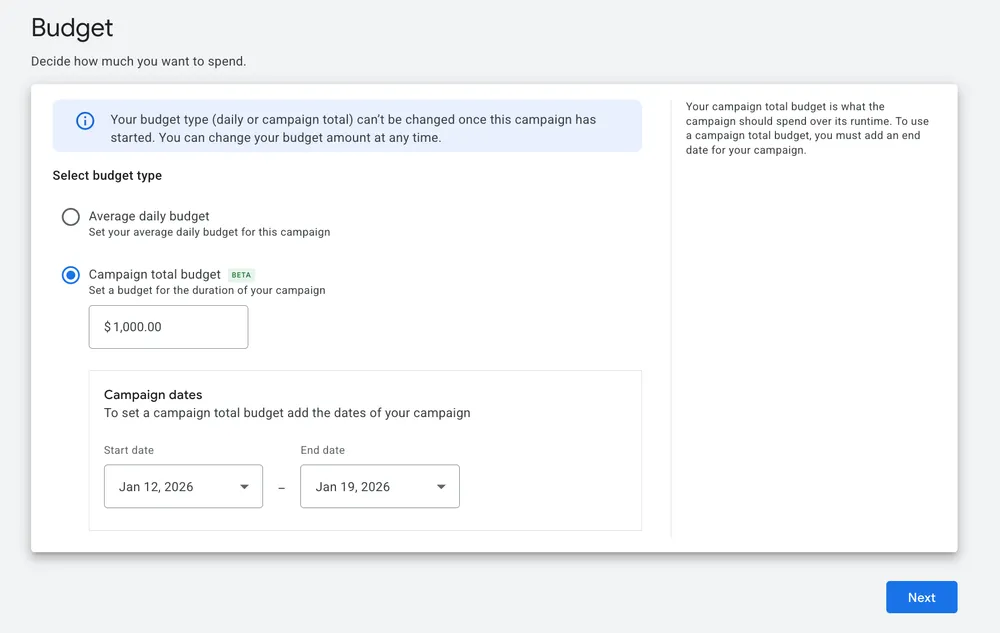
Campaign Total Budgets are now available (open beta) for Search, Performance Max, and Shopping campaigns. Instead of managing daily budgets and constantly adjusting pacing, advertisers can now set one fixed budget over a defined time period and let Google handle how that spend is distributed.
On the surface, it sounds simple. In practice, it solves a problem many advertisers have wrestled with for years, especially during promotions, launches, and limited-time pushes.
This guide breaks down what campaign total budgets are, how they work, where they shine, and when you should think twice before using them.

Campaign Total Budgets allow you to set a single budget for the entire duration of a campaign, rather than assigning a daily spend limit.
You choose:
Google then automatically paces spend across that window, adjusting daily spend based on demand, competition, and performance signals.
Instead of asking, “Did we spend too much today?”, the system focuses on a different question:
How do we use the full budget effectively by the end date?
As of this update, Campaign Total Budgets are supported in:
While Performance Max has leaned into automated pacing for some time, extending this capability to Search and Shopping is a meaningful shift. It gives advertisers more flexibility without forcing them into fully automated campaign types.
Short-term campaigns have always been awkward to manage in Google Ads.
Daily budgets require constant attention. Spend can lag early in a campaign, then spike late as you try to catch up. Miss a few days of monitoring, and suddenly you’re either underspent or scrambling to rein things in.
Campaign Total Budgets are Google’s answer to that friction.
By removing daily limits, Google can respond more fluidly to auction conditions – spending more when demand is strong and easing off when it isn’t, all while staying within the total budget you’ve set.
For advertisers running promotions or fixed-window campaigns, that’s a meaningful shift.
When you enable a campaign total budget:
A few important things to know upfront:
This makes planning more important than usual. You’re committing to a structure, not just a number.
Escentual.com, a UK-based online beauty retailer, used campaign total budgets during a promotional period when their ads weren’t serving as consistently as expected.
The issue wasn’t performance—it was pacing. Their budget wasn’t being fully utilized while demand was high.
After switching to a campaign total budget, they saw:
According to Tom Jenkins, Insights Manager at Escentual.com:
“The campaign total budget feature helped us hit our traffic goals without exceeding our budget.”
That outcome reflects where this feature performs best: time-bound campaigns where opportunity isn’t evenly distributed day by day.
Campaign total budgets tend to work best when:
In real accounts, this often means fewer mornings spent checking spend and more time focusing on creative, search terms, and landing page performance.
This feature isn’t a universal upgrade.
Because Google controls pacing, you give up some day-to-day control. Spend can cluster toward certain days if demand spikes, which is fine when conversion tracking is solid, but risky when it isn’t.
Campaign total budgets may not be a good fit if:
In accounts with limited data, automation like this can amplify small tracking issues.
Use campaign total budgets if:
Avoid them if:
Use with caution if:
The key question isn’t “Is this feature good?” it’s “Is this the right tool for this campaign?”
If you decide to use campaign total budgets:
Think of this as a pacing tool, not a performance guarantee.
Campaign Total Budgets give advertisers more control over outcomes while reducing the need for daily budget management.
For short-term, high-intent campaigns, they can be a genuine improvement. For evergreen campaigns, daily budgets still have their place.
Like most Google Ads updates, the advantage doesn’t come from the feature itself, it comes from knowing when to use it and when not to.
Performance Marketing Experts
The Magic Clickz team is a group of experienced PPC agency specialists, digital marketers, designers, and developers focused on helping businesses scale through performance-driven marketing.
As website experts, Google Ads experts, and Meta Ads experts, we specialize in building and managing high-converting campaigns backed by data, strategy, and continuous optimization.
Through our blogs, we share practical insights, proven PPC strategies, and real-world experience across PPC management services, Google Ads, Meta (Facebook & Instagram) advertising, conversion optimization, and website performance empowering brands to make smarter marketing decisions and achieve measurable growth.
Join our Newsletter
Get weekly insights, updates, and industry trends












Do you want more conversions?
Stay ahead and discover digital trends, strategies, and innovation with us



© 2026. MAGIC CLICKZ, ALL RIGHTS RESERVED