
We’re a team of digital growth experts sharing insights, tips, and resources to help businesses perform better online. Simple. Actionable. Effective.
We’re a team of digital growth experts sharing insights, tips, and resources to help businesses perform better online. Simple. Actionable. Effective.
Google Ads has been steadily moving away from keyword-only targeting for years.
Broad match, Smart Bidding, and automated creatives all pointed in the same direction: intent matters more than exact phrasing.
AI Max is Google making that shift explicit.
If you’ve recently seen AI Max appear inside your Search campaigns, or heard agencies debating whether it’s helpful or dangerous you’re not alone. For many businesses, it raises an important question:
Is AI Max a smarter way to scale Search campaigns, or just another layer of automation that reduces control?
This guide explains what AI Max actually is, how it works, how it compares to Performance Max, and when businesses should (and shouldn’t) use it, without sales hype or platform jargon.
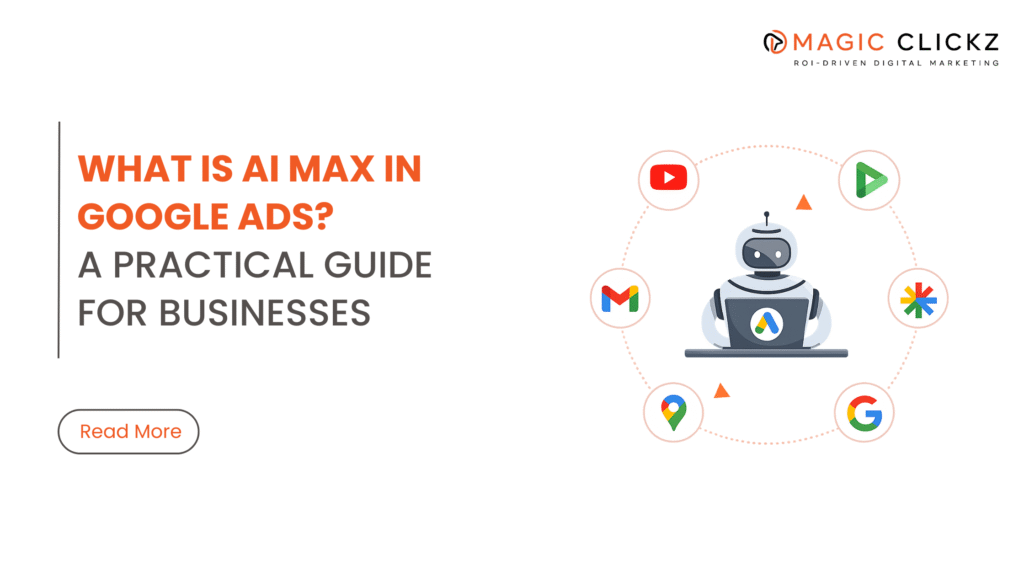
AI Max is an opt-in enhancement inside standard Google Search campaigns.
It does not replace Search campaigns, and it does not turn your account into Performance Max. Instead, AI Max expands how Google interprets search queries and dynamically adapts ad assets—while keeping your existing keyword structure in place.
In simple terms:
You still choose the keywords, but Google gets more freedom in how it matches intent and serves ads.
AI Max is designed to help Search campaigns capture:
More long-tail and conversational searches
Queries that don’t match keywords exactly but signal strong intent
Additional reach without rebuilding campaign structure

Search behavior has changed faster than keyword strategy.
People no longer search in short, exact phrases. They search in:
Full questions
Problem-based language
Contextual and conversational terms
Exact and phrase match alone can no longer keep up with that complexity. Google introduced AI Max to:
Expand intent coverage
Reduce setup friction for advertisers
Let machine learning connect signals faster than manual keyword lists
For small and mid-sized businesses, this means less dependence on perfect keyword mapping, but also more reliance on data quality and account discipline.
AI Max operates through three core mechanisms:
AI Max allows Google to go beyond literal keyword matches and trigger ads for searches that show similar intent.
This is more advanced than traditional broad match because it considers:
Search context
User behavior signals
Conversion likelihood
The benefit is wider reach.
The risk is irrelevant traffic if guardrails aren’t in place.
Instead of serving the same static headlines to every user, AI Max dynamically assembles ad copy using:
Your approved headlines and descriptions
On-site messaging
Contextual signals from the search query
This helps improve relevance and click-through rate but only if your ad assets are clear, specific, and conversion-focused.
When enabled, Google can choose the most relevant page on your website for each query.
This can:
Improve alignment between intent and content
Increase reach without creating new landing pages
But it also introduces risk if:
Pages aren’t conversion-ready
Messaging varies across the site
You prefer tight control over traffic destinations
Most businesses should start with restrictions, not full freedom.
AI Max is not automatically good or bad. It depends on readiness.
Conversion tracking is accurate
You already use Smart Bidding
Your services or products are clearly defined
Your website messaging is consistent
You want more reach without restructuring campaigns
Lead quality is already inconsistent
You rely on extremely tight intent (legal, medical, high-CPC niches)
You don’t review search term reports regularly
Your website has mixed or unclear messaging
More automation increases performance only when foundations are solid.
AI Max doesn’t usually fail dramatically, it fails quietly.
Common issues include:
Ads showing for “research-stage” queries instead of buyer intent
Higher lead volume with lower close rates
Reduced visibility into why certain queries triggered ads
Budget being consumed during learning phases without clear gains
Landing pages chosen for relevance, not conversions
A key agency insight:
AI Max doesn’t break accounts. Lack of oversight does.
To set expectations correctly:
AI Max is not a replacement for keyword strategy
It is not a shortcut for weak landing pages
It is not “set it and forget it” automation
It is not Performance Max for Search
Think of AI Max as assisted control, not hands-off management.
AI Max is an optional enhancement within Google Search campaigns that uses artificial intelligence to expand keyword matching, customize ad copy, and improve intent-based targeting. It allows Google to show ads for relevant searches beyond exact keyword matches while keeping your existing Search campaign structure intact.
Google Ads AI Max for Search campaigns is designed to help advertisers capture more high-intent searches by using machine learning to interpret user intent rather than relying only on exact keywords. It works within Search campaigns and helps improve reach, relevance, and performance when managed correctly.
Google Ads is an online advertising platform that allows businesses to show ads on Google’s search results, websites, YouTube, Gmail, and other Google properties. Advertisers only pay when users take an action, such as clicking an ad or calling the business.
Yes, Google Ads can be worth it when campaigns are set up properly and tracked correctly. Businesses benefit most when they target high-intent searches, use clear messaging, and continuously optimize campaigns. Poor setup or lack of management often leads to wasted spend, not poor platform performance.
Google Ads works on an auction system. Advertisers bid on keywords or audiences, and Google uses factors like bid amount, ad relevance, and landing page experience to decide which ads appear. You only pay when someone clicks your ad or completes a defined action.
Google Ads can appear across multiple Google-owned platforms, including:
Google Search results
YouTube
Google Display Network websites
Gmail
Google Maps
Google Discover
The placement depends on the campaign type and settings.
A Google Ads agency manages and optimizes advertising campaigns on behalf of businesses. This includes keyword research, ad creation, bid management, conversion tracking, landing page guidance, performance reporting, and ongoing optimization to improve return on ad spend.
A Google Ads agency is a specialized marketing firm that helps businesses plan, run, and optimize Google Ads campaigns. Agencies use expertise, data, and testing to reduce wasted spend, improve lead quality, and scale campaigns more efficiently than most in-house setups.
Small businesses don’t always need an agency, but working with one can save time and prevent costly mistakes. An experienced agency helps ensure proper targeting, budget control, and performance tracking—especially when using automated features like Smart Bidding or AI Max.
If you plan to test AI Max, start deliberately:
Enable it in one campaign first
Use strict negative keywords
Limit landing page expansion initially
Review search terms weekly
Measure success by lead quality, not volume
Be prepared to roll back if signals deteriorate
Small tests outperform big switches.
AI Max reflects where Google Search is heading—toward intent-driven, automated decision-making.
For businesses that understand their funnel, track conversions properly, and actively manage campaigns, AI Max can unlock incremental growth.
For businesses seeking full control without ongoing review, it can introduce risk.
AI Max is a tool. Results depend on how intentionally it’s used.
Performance Marketing Experts
The Magic Clickz team is a group of experienced PPC agency specialists, digital marketers, designers, and developers focused on helping businesses scale through performance-driven marketing.
As website experts, Google Ads experts, and Meta Ads experts, we specialize in building and managing high-converting campaigns backed by data, strategy, and continuous optimization.
Through our blogs, we share practical insights, proven PPC strategies, and real-world experience across PPC management services, Google Ads, Meta (Facebook & Instagram) advertising, conversion optimization, and website performance empowering brands to make smarter marketing decisions and achieve measurable growth.
Join our Newsletter
Get weekly insights, updates, and industry trends










Do you want more conversions?
Stay ahead and discover digital trends, strategies, and innovation with us
© 2026. MAGIC CLICKZ, ALL RIGHTS RESERVED