We’re a team of digital growth experts sharing insights, tips, and resources to help businesses perform better online. Simple. Actionable. Effective.
Magic Clickz Team
We’re a team of digital growth experts sharing insights, tips, and resources to help businesses perform better online. Simple. Actionable. Effective.
Google doesn’t usually make noise about its most impactful PPC changes.
This is one of them.
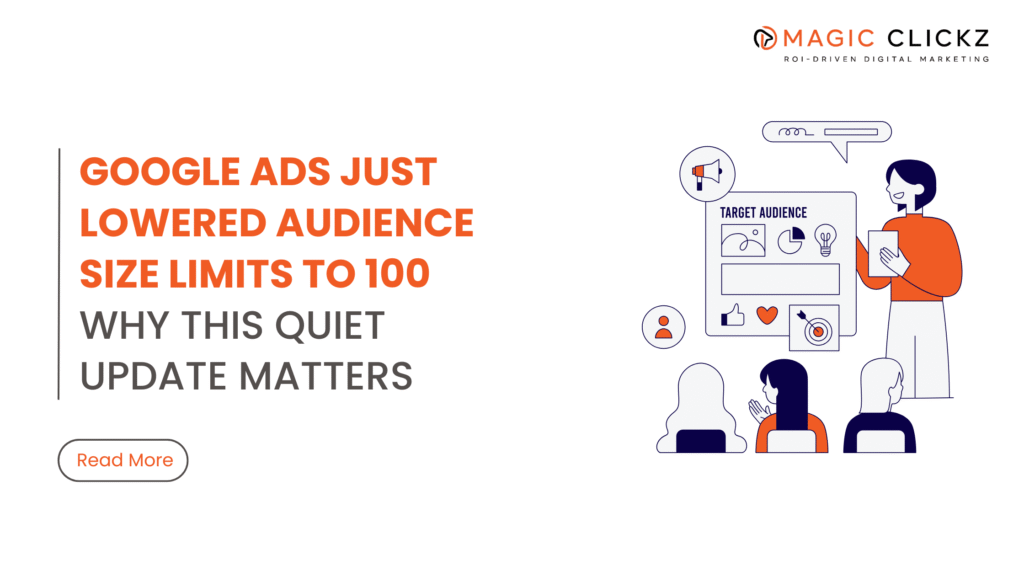
Google has reduced the minimum audience size requirement to just 100 users across Search, Display, and YouTube. This applies to remarketing lists, customer lists, and Audience Insights down from the long-standing 1,000-user threshold.
On the surface, it looks like a small technical update.
In reality, it removes a structural barrier that has quietly shaped how advertisers, whether working with a PPC agency or operating as a digital marketing agency in Indore managing lean accounts have been forced to run Google Ads for years.
What Changed (Clearly and Completely)
Audience segments with as few as 100 active users can now be used:
Across all three networks: Search, Display, and YouTube
Across all segment types: Remarketing lists and Customer lists
At the same time, the threshold for a segment to appear in Audience Insights has also dropped from 1,000 to 100 users.
This isn’t a partial rollout or a limited exception. Google has now standardized the 100-user requirement across all networks and all audience types, removing inconsistencies that previously made audience strategies harder to deploy.
Google began this shift back in May, when the minimum size for Customer Lists in Search campaigns was reduced from 1,000 to 100. Since then, the limits have been gradually lowered across the platform, culminating in this full alignment.
Why This Matters More Than It Sounds
For years, Google Ads quietly rewarded scale over precision.
If your account didn’t have thousands of users, you couldn’t:
Run meaningful remarketing
Activate customer list targeting
Layer audiences effectively
Access actionable Audience Insights
This limitation hit smaller advertisers the hardest including many digital marketing companies in Indore working with niche, regional, or early-stage brands.
They weren’t bad at PPC.
They were forced into broad targeting because the platform gave them no alternative.
That changes now.
With a 100-user threshold, intent finally matters more than volume.
This update isn’t about using tiny audiences everywhere.
It’s about using them where intent already exists.
The biggest impact will show up in:
Search campaigns, where remarketing or customer lists can refine high-intent keywords
YouTube and Display remarketing, focused on real past engagement not awareness
Audience Insights, which were largely unusable for smaller accounts until now
A list of 120 past customers or 150 site visitors may not look impressive but when layered correctly, it can materially improve relevance, efficiency, and message alignment.
The Hidden Risk of Smaller Audiences
There’s a trade-off Google isn’t highlighting.
Smaller audiences amplify mistakes.
With lists this tight:
Poor tracking becomes obvious immediately
Generic messaging fails faster
Weak landing pages convert even worse
Broad targeting hides inefficiencies.
Precision exposes them.
As access expands, Google has also updated its official audience segment documentation with clearer policy and troubleshooting guidance, another signal that clean data and compliance matter more when audiences shrink.
What This Signals About Google Ads Going Forward
This update isn’t just about accessibility.
It’s about first-party data and cleaner signals.
As automation takes over bidding and targeting, Google needs better inputs—not bigger ones.
Lowering audience thresholds nudges advertisers toward building owned data, segmenting intentionally, and feeding AI higher-quality signals.
Bottom Line
By lowering audience size limits to 100 users, Google is opening advanced audience targeting to a much broader range of advertisers.
But this isn’t a shortcut.
It’s a test.
Because when audiences get smaller, strategy matters more than ever.
The advertisers who win won’t be the loudest or the biggest.
They’ll be the most precise.
First seen: This update was first spotted by Web Marketing Consultant Dario Zannoni, who shared it on LinkedIn.
The Magic Clickz team is a group of experienced PPC agency specialists, digital marketers, designers, and developers focused on helping businesses scale through performance-driven marketing.
As website experts, Google Ads experts, and Meta Ads experts, we specialize in building and managing high-converting campaigns backed by data, strategy, and continuous optimization.
Through our blogs, we share practical insights, proven PPC strategies, and real-world experience across PPC management services, Google Ads, Meta (Facebook & Instagram) advertising, conversion optimization, and website performance empowering brands to make smarter marketing decisions and achieve measurable growth.
We’ve been working with Magic Clickz for several months now for our Google Ads campaigns, and the experience has been very smooth and effective. Their team is responsive, knowledgeable, and always ready to help with suggestions to improve performance.
Magic Clickz has been a great partner in my online marketing business. They have added a strong knowledge and execution of Meta and google ADs which has resulted in and increase in business.
We’re excited to continue this partnership and look forward to achieving even greater milestones together. We highly recommend Magic Clickz to anyone looking for a smooth and result oriented digital marketing services!
I've had an outstanding experience working with Magic Clickz! They have been incredibly knowledgeable, professional, and proactive in optimizing my campaigns. Thanks to their expertise, we've seen a noticeable improvement in both traffic and conversions.
Have been working with Magic Clickz with more than a year now and thanks to them my business runs automatically! Thank you so much!
I hired Magic Clickz a couple of months ago after speaking to several marketing companies, I believed my decision has been justified. They are always available to speak to and discuss strategy. They regularly consult with me regarding future strategy.
Case Studies
Luxury Kitchen Design Digital Advertising Success: Driving Quality Leads and Engagement
Achieving Outstanding ROAS and Over 1,900 Conversions with Targeted Google Ads Campaigns
Click Here
My Personal Mentors' Lead Surge: Transforming Outreach with Google Ads
How Strategic Google Ads Campaigns Helped MPM Drive 115M+ Impressions, 564 Leads & a SO.46 Avg CPO
Click Here
Tabebuia’s Google Ads Success: Amplifying Bookings & Awareness for a Luxury Dining Experience
How Strategic Google Ads Campaigns Helped Tabebuia Drive
386K+ Clicks, 6.6K+ Conversions & Over 75M Impressions
Click Here
Do you want more conversions?
Hey, we’re the Magic Clickz Team. We help brands scale with performance marketing.
The only question is… will yours be next?